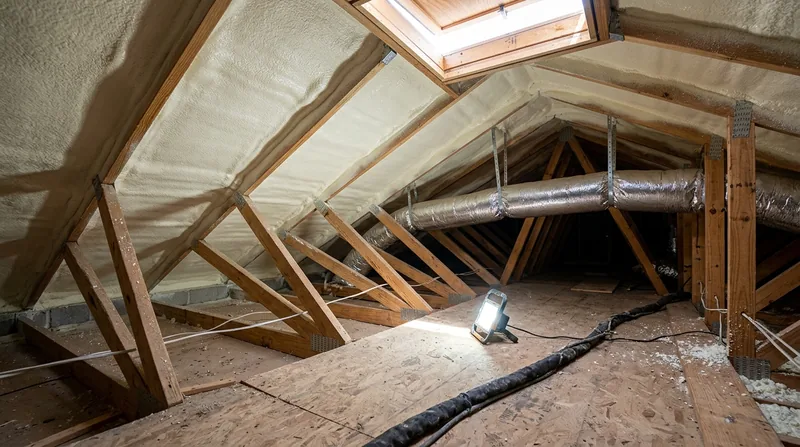




Attic spray foam insulation in McAllen transforms the hottest room in your home from a heat-radiating liability into conditioned space. Every McAllen attic sits above a concrete slab and carries the air handler and ductwork, running 150 to 160 degrees Fahrenheit under the brutal Rio Grande Valley sun for most of the year. Open-cell foam sprayed directly onto the roof deck seals air leaks, stops radiant heat, and brings the HVAC equipment inside the thermal envelope where it belongs. We provide written estimates with R-value and thickness specifications for every job, and we've been doing this work since 2012 across Greater McAllen, from historic downtown Harlingen and Mission to the fast-growing north McAllen suburbs and the farm and produce-warehouse corridor toward Pharr and Weslaco.
Why Attic Spray Foam Insulation Matters in the Rio Grande Valley
McAllen's climate is the primary driver: semi-arid subtropical, with summer highs routinely exceeding 95 degrees and Gulf humidity that pushes moisture vapor inward year-round. Most homes sit on slab-on-grade with a vented attic overhead, and that attic becomes a solar oven. Fiberglass batts and blown-in cellulose settle, compress, and develop gaps around ducts and penetrations, allowing conditioned air to escape and unconditioned heat to pour in. Attic temperatures that peak at 160 degrees degrade insulation R-value, shorten air conditioner life, and push cooling costs upward every month from May through October. Spray foam adheres directly to the roof deck, seals every crack and duct penetration in a single pass, and creates a continuous air barrier that fiberglass cannot match.
- Spray foam stops air leaks around HVAC ducts, electrical chases, and soffit vents that fiberglass cannot seal.
- Open-cell foam on the roof deck keeps the air handler and ductwork inside the conditioned envelope, eliminating the efficiency penalty of cooling the attic itself.
- Sealed attics reduce the moisture vapor drive that plagues vented attics in humid climates, lowering mold risk in old frame and stucco homes.
- A properly sprayed attic reduces cooling load and extends the life of air conditioning equipment in homes across McAllen, Edinburg, Mission, and Pharr.
These are the reasons attic foam is the signature job in the trade and the highest-value retrofit for Valley homeowners.
Local example: A 1970s brick-veneer ranch in south McAllen with a vented attic and original fiberglass often sees attic temps of 155 to 160 degrees by mid-afternoon in June. Open-cell foam on the roof deck and sealed rim joists can drop cooling costs by 12 to 18 percent, depending on the starting condition and the existing ductwork layout.
For more details on how open-cell foam performs in Valley attics, see our guide to open-cell spray foam insulation.
How We Install Attic Spray Foam in McAllen
Installation begins with a site assessment: we measure the attic square footage, identify all duct runs and HVAC penetrations, and check the substrate for moisture, contamination, or roof leaks. If the attic is wet or the roof is actively leaking, we do not spray. We fix the moisture first or we walk away. Once the attic is dry and ready, we set up mechanical ventilation to manage off-gassing during the cure window, establish a safety perimeter, and spray the foam in controlled passes to the specified thickness and R-value. Every estimate lists the board footage, the R-value achieved, and the thickness per pass. We provide a twenty-four to forty-eight hour re-entry window, during which the attic must remain unoccupied and ventilation must run continuously.
- We inspect the attic for active leaks, moisture, or contaminated insulation before we commit to a spray date.
- We set up mechanical ventilation during the cure window to manage isocyanate vapor and ensure safe air quality for the home.
- We spray foam in controlled thickness passes, measuring as we go, to deliver the R-value and board footage promised in the estimate.
- We seal all ductwork penetrations, rim joists, and soffit vents in the same pass, eliminating air leaks that fiberglass installation leaves behind.
- We provide a detailed re-entry window and post-cure care instructions, including when HVAC equipment can safely resume operation.
This methodical approach is the difference between a spray foam job that delivers lasting comfort and one that leaves homeowners dealing with off-gassing complaints and performance questions.
Real McAllen scenario: A 2000-square-foot two-story in north McAllen with a 1,200-square-foot attic, bonus room, and a three-car garage typically requires 400 to 500 board feet of open-cell foam to achieve R-38 to R-49 on the roof deck. The job takes one day, with mechanical ventilation running for 48 hours post-spray before the HVAC system and attic access are cleared for use.
For a walkthrough of how we handle wall and injection foam in older Valley homes, visit our page on wall and injection foam insulation.
| Approach | Description | Best For |
|---|---|---|
| Open-Cell Foam on Roof Deck | Low-density foam (0.5 lb/cu ft) sprayed directly to the underside of the roof sheathing, creating a continuous air barrier and thermal break. Cures in 24 to 48 hours. Allows minor vapor transmission and is the most cost-effective attic retrofit for Valley climates. | Standard McAllen attics with vented soffit vents or soffit closure. Typical target: R-38 to R-49 on the roof deck. |
| Closed-Cell Foam on Roof Deck | High-density foam (1.5 to 2.0 lb/cu ft) sprayed to the roof deck. Provides higher R-value per inch, full vapor barrier, and structural reinforcement. More expensive than open-cell but required for humid environments with condensation risk or when maximum R-value in minimal space is the goal. | Retrofit attics in older frame homes near the Rio Grande where vapor control is critical. Also used when bonus rooms or conditioned attics are planned. |
| Attic Rim and Band Joist Sealing | Open-cell foam sprayed into the rim joist cavity where the floor frame meets the top of the foundation wall. Seals the largest air leak path in slab-on-grade homes. Often paired with attic roof-deck foam for complete envelope sealing. | Every McAllen slab-on-grade home. The rim joist is the primary infiltration path and should be sealed whenever attic work is planned. |
| Blown-In Cellulose Top-Up | Dry cellulose blown over existing fiberglass or mineral wool to add R-value without removing the old insulation. No spray, no cure window, no ventilation required. Appropriate only when the existing insulation is sound and air sealing is not the goal. | Adding R-value to an attic with intact fiberglass and no air-leak problems. Not a replacement for spray foam when air sealing is needed. |
Attic Spray Foam Insulation Cost in McAllen: What to Expect
Attic spray foam pricing in McAllen typically starts at $1.50 to $2.50 per square foot for open-cell foam on the roof deck, depending on attic size, existing insulation removal, and the R-value target. A typical 1,200-square-foot attic requiring 400 to 500 board feet of open-cell foam to reach R-38 to R-49 runs between $1,800 and $3,000, plus the cost of removing and disposing of old fiberglass or mineral wool if present. Closed-cell foam costs more per board foot because of its higher density and superior R-value, making it the choice when vapor control or maximum R-value in minimum space is the priority. Site-specific factors that affect the final price include attic accessibility, the condition of existing insulation, whether rim joists and soffit vents are included, and the distance from our shop to your address.
- Open-cell foam on the roof deck is the most economical choice for standard McAllen attics and delivers R-38 to R-49 in a single pass.
- Closed-cell foam costs more but provides superior vapor control and higher R-value per inch for older homes or humid environments.
- Removal of existing fiberglass, cellulose, or failed foam is billed separately and is often necessary before spray work can begin.
- Rim joist and band joist sealing typically adds $400 to $800 to an attic job but is the single biggest air-sealing opportunity in a slab-on-grade home.
- Every estimate includes the board footage, R-value, thickness per pass, and a breakdown of labor and material costs with no hidden fees.
For a detailed breakdown of pricing across all our services, visit our pricing overview page.
What to Look for When Hiring an Attic Spray Foam Contractor Near McAllen
Choosing the right spray foam contractor is as important as the product itself. The market includes rig-and-run crews operating out-of-state trailers (spray a job in an afternoon, disappear when the smell does not go away) and national franchises with corporate overhead, and then there are the local independents who live in the community and stand behind their work. Here is how to evaluate any contractor, including us. First, ask for a written estimate that lists the R-value, thickness per pass, and total board footage. If an estimate has no R-value and no thickness, you are talking to someone who does not know the trade. Second, ask about mechanical ventilation during the cure window. Legitimate installers run mechanical ventilation for 24 to 48 hours post-spray to manage off-gassing. Anyone promising immediate re-entry or no ventilation requirement is cutting corners. Third, verify insurance. We are fully insured, and any contractor worth hiring can provide a certificate of insurance with limits that cover spray foam work. Fourth, ask about permits. Permitting varies by city across Greater McAllen, and your contractor should help you navigate what applies at your address. Fifth, check references from recent jobs in your area. A contractor who has done work in McAllen, Harlingen, Brownsville, or Pharr should have homeowners willing to talk about the job and the outcome.
- Request a written estimate that specifies R-value, thickness per pass, board footage, and material and labor costs with no vague line items.
- Confirm that the contractor runs mechanical ventilation during the cure window and provides a clear re-entry timeline of 24 to 48 hours.
- Verify insurance with a current certificate of insurance showing coverage for spray foam insulation work.
- Ask about the contractor's process for navigating local permitting and registration requirements at your specific address.
- Request references from recent jobs in your city or nearby, and contact at least two homeowners to discuss their experience and the quality of the finished work.
For a free, no-obligation estimate from our crew, contact us today or call (956) 540-5716.
Attic Spray Foam Insulation in McAllen: Pricing Guide
| Service | Price | Details |
|---|---|---|
| Open-Cell Foam on Roof Deck | Starting at $1.50/sq ft | Low-density foam to R-38 to R-49 coverage; cost varies by attic square footage and R-value target |
| Closed-Cell Foam on Roof Deck | Starting at $2.25/sq ft | High-density foam for vapor control and maximum R-value; typical in older homes or humid retrofit scenarios |
| Rim Joist and Band Joist Sealing | Starting at $400 | Air-sealing the rim cavity where floor frame meets foundation; included or added to attic jobs |
| Insulation Removal and Disposal | Starting at $0.50/sq ft | Removal of existing fiberglass, cellulose, or failed foam before spray work begins; cost depends on attic size and disposal distance |
| Full Attic Retrofit (Foam Plus Removal) | On estimate | Complete job including old insulation removal, new foam installation, rim joist sealing, and all air sealing requires site inspection |
| Free Estimate | No charge | Written estimate with R-value, thickness, board footage, and itemized pricing; response within 24 hours at (956) 540-5716 |
Indicative pricing, the exact cost depends on square footage, finish, and site access. Free personalized estimate within 24h at (956) 540-5716.


