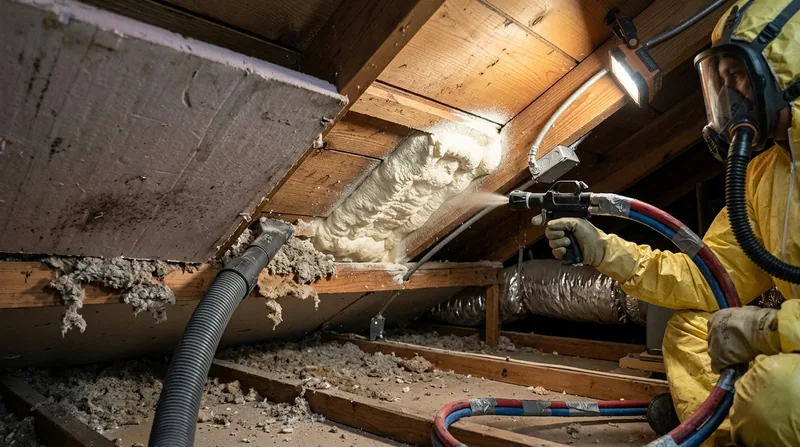




Insulation Replacement & Re-Insulation in McAllen is the full reset: old material removed, gaps sealed, new foam installed to current code. In the Rio Grande Valley, where summer attic temperatures routinely hit 150 to 160 degrees Fahrenheit under some of the hottest sun in Texas, flattened insulation or foam damaged by humidity and heat loss compounds every month of cooling season. Whether your attic carries decades of compressed fiberglass, hurricane-soaked batts, or spray foam that has failed, the job is the same: tear it out, air-seal the rim and band joists, and install new closed-cell or open-cell foam to specification. This is the right call when insulation is fouled by rodents, when a new roof is going on anyway, or when energy bills tell you the old material has stopped working.
Why Insulation Replacement Matters in McAllen's Hot, Humid Climate
McAllen sits on a concrete slab, and above it sits a vented attic that carries the air handler and ductwork. That attic is the hottest room in your house for eight months a year. When the original insulation settles, compresses, or absorbs moisture from the subtropical Gulf air, R-value drops fast. The cost of running your AC climbs every degree the attic temperature rises. A full replacement is not a cosmetic upgrade; it is the foundation of energy performance in the Valley.
- Remove old, settled, or water-damaged insulation and dispose of it properly.
- Air-seal all rim joists, band joists, and gaps around ductwork and penetrations.
- Install new spray foam to the R-value and thickness specified by the current energy code for Hidalgo County.
- Ensure mechanical ventilation during cure and a twenty-four to forty-eight hour re-entry window before occupancy.
- Provide a written estimate with R-value and thickness specs before any work begins.
A full replacement gives you a fresh baseline for thermal control and air sealing in one job.
Key info: Many McAllen homes built in the 1960s through 1980s have attics filled with loose fiberglass or batts that have settled 2 to 3 inches below the joists. That gap is a thermal highway. Replacement foam fills every cavity and seals the air boundary in one pass.
For more detail on the specific insulation types we install, see our guide to closed-cell spray foam insulation, which is the most common choice for McAllen attics because it stops moisture and holds its R-value under high heat.
How Insulation Replacement Works in McAllen: Step by Step
The process is straightforward but requires discipline. We remove the old material completely, vacuum and sweep the attic floor, identify and seal air leaks at the rim joist and around all penetrations, then spray new foam to specification. The entire job is done in one or two days, depending on attic size and complexity. Mechanical ventilation runs during cure, and we provide a re-entry timeline before the attic is safe for foot traffic or storage.
- Schedule a free on-site estimate; we measure the attic and note any existing damage or moisture.
- Remove all old insulation, batts, or failed foam and haul it away.
- Inspect and seal air leaks at the rim joist, band joist, and around ductwork, wiring, and roof penetrations.
- Spray closed-cell or open-cell foam to the specified R-value and thickness.
- Run mechanical ventilation during cure and provide a written re-entry window (typically 24 to 48 hours).
- Walk the attic with you when cure is complete and answer any questions about maintenance or future access.
The result is an attic that is thermally tight, air-sealed, and ready to perform in the Valley heat.
Example: A 1970s ranch in Pharr with a 1,200-square-foot attic full of settled fiberglass and a west-facing roof that bakes in afternoon sun. Replacement with 5.5 inches of closed-cell foam (R-33) seals all the rim gaps, stops the humid air from entering, and cuts the cooling load noticeably within the first month. The homeowner notices the difference on the electric bill and in the feel of the upstairs bedrooms.
If you have questions about whether your attic is a candidate for replacement or a top-up, our team can walk you through the options during the estimate. Call (956) 540-5716 or visit our attic spray foam insulation page for more detail on how we approach the biggest energy project in most homes.
Methods: Closed-Cell vs. Open-Cell for Replacement
| Approach | Description | Best for |
|---|---|---|
| Closed-Cell Spray Foam | High-density foam (3.5 to 4 pounds per cubic foot) that stops air and moisture. Requires mechanical ventilation during cure. Low-VOC once cured. Provides R-6 to R-7 per inch. | McAllen attics with high humidity, west-facing roofs, or homes near the coast where salt air and moisture are a threat. |
| Open-Cell Spray Foam | Lower-density foam (0.5 to 1 pound per cubic foot) that allows vapor to pass through. Softer, easier to cut. Provides R-3.5 to R-4 per inch. Requires mechanical ventilation during cure. | Attics where sound dampening is a priority, or where closed-cell cost is a concern and the roof deck is vented. |
| Blown-In Fiberglass or Cellulose (Top-Up Only) | Loose-fill insulation blown into existing cavities. No air sealing. No cure time. Lower cost per square foot. | Only when the existing attic structure is sound, rim joists are already sealed, and you are adding depth to good insulation, not replacing failed material. |
| Removal and Replacement Package | Full tear-out of old material, haul-away, air sealing, and new foam installation. Includes inspection and written R-value specs. | Any attic with settled, water-damaged, or rodent-fouled insulation, or when a new roof is being installed. |
Insulation Replacement & Re-Insulation Cost in McAllen: What to Expect
The cost of a full insulation replacement depends on attic size, the type of foam you choose, the complexity of air sealing needed, and haul-away logistics. A typical 1,200-square-foot attic in a 1970s ranch runs from $2,800 to $4,500 for closed-cell foam replacement, including removal and air sealing. Open-cell is usually 15 to 25 percent less. The biggest variables are the condition of the existing insulation (some tear-out is faster than others), the number of penetrations and gaps to seal, and roof pitch or truss configuration that affects spray access.
- Get a written estimate that includes the square footage, R-value, thickness, and type of foam.
- Ask for the cost breakdown: removal and haul, air sealing, foam installation, and ventilation.
- Get two or three estimates from different contractors; compare the R-value and thickness specs, not just the price.
- Ask whether the price includes mechanical ventilation during cure and the re-entry timeline.
The cheapest estimate is often the one missing air sealing or specifying thinner foam. The right estimate is the one that names the R-value, the thickness per pass, and the number of passes. For a detailed breakdown of pricing across all our services, visit our pricing page.
Real example: A historic frame home in downtown Harlingen built in the 1930s with a pier-and-beam foundation and an uninsulated attic. Replacement with 5.5 inches of closed-cell foam (R-33) and full rim joist sealing cost $3,200. The homeowner also gained the option to store items in the attic without worrying about temperature swings or moisture.
What to Look for When Hiring a Spray Foam Insulation Contractor Near McAllen
Not all insulation contractors are equal. Some are one-rig operations that spray fast and disappear; others are national franchises that subcontract work and are hard to reach when the smell lingers or the foam is thin. The local independent shop with a local address, local plates, and a reputation in the community is a safer bet. Here is what to verify before you hire.
- Ask for proof of general liability and workers compensation insurance; confirm coverage limits are adequate for your job.
- Request a written estimate that specifies R-value, thickness per pass, the type of foam, and the cost of removal and air sealing separately.
- Ask whether the contractor holds any municipal contractor registration required by your city (McAllen, Pharr, Harlingen, or others); verify it with the city before work begins.
- Check references from jobs completed in the last two years; call at least two and ask about cure time, smell, and whether the contractor was reachable after the job.
- Confirm that mechanical ventilation will run during cure and that you will receive a written re-entry timeline (24 to 48 hours).
- Ask about the warranty on workmanship; honest contractors offer one to three years, not a lifetime claim.
The contractor who can explain the difference between closed-cell and open-cell, who names the R-value and thickness before spraying, and who insists on mechanical ventilation during cure is the one who knows the trade. For a free estimate and to ask any questions about our process, contact us today or call (956) 540-5716. We are fully insured, based in McAllen, and ready to walk you through the entire replacement process.
Insulation Replacement & Re-Insulation in McAllen: Pricing Guide
| Service | Price | Details |
|---|---|---|
| Attic Insulation Replacement (Closed-Cell) | Starting at $2,800 | Includes removal, haul-away, rim joist air sealing, and 5.5 inches closed-cell foam. Typical 1,200-square-foot attic; larger attics scale up |
| Attic Insulation Replacement (Open-Cell) | Starting at $2,200 | Includes removal, haul-away, basic air sealing, and open-cell foam to code R-value. Cost-friendly alternative for vented attics |
| Complex Attic or Multiple Zones | On estimate | Historic homes with multiple attic sections, pier-and-beam with crawl space rim, or homes with prior failed foam require on-site inspection |
| Travel and Logistics | Included | No separate mileage fee or call-out charge within McAllen and surrounding Rio Grande Valley service areas |
| Free Estimate | No charge | Written estimate with R-value and thickness specs. Response within 24 hours at (956) 540-5716, no obligation to book |
Indicative pricing, the exact cost depends on square footage, finish, and site access. Free personalized estimate within 24h at (956) 540-5716.


