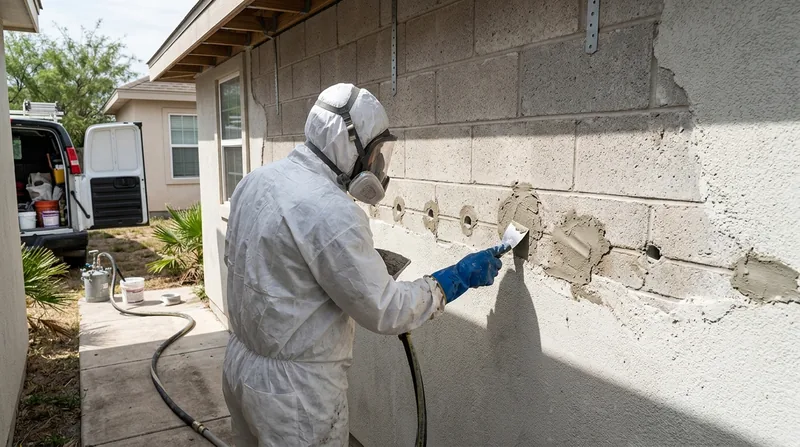




Wall & Injection Foam Insulation in McAllen is the retrofit answer for the Valley's 1960s-80s brick-veneer and frame-and-stucco ranches that dominate the residential landscape from south McAllen through Pharr, San Juan, Weslaco and Mercedes. These homes were built with hollow cavity walls, no insulation, and the brutal west-facing exposures that run 150 to 160 degrees Fahrenheit under the Rio Grande Valley's relentless subtropical sun. Injection foam fills those cavities through small drilled ports without demolition, without tearing into drywall or stucco, and without the weeks of disruption that come with traditional retrofit work. The ports are patched to match the existing surface. For homeowners tired of cooling an uninsulated wall, injection foam delivers R-value where it matters most, and it does it in a single day.
Why Injection Foam Insulation Matters for McAllen's Older Homes
The 1960s-80s ranch stock that fills south McAllen and the surrounding towns was built fast and cheap, and insulation was an afterthought. Brick veneer over wood frame, stucco over frame, hollow cavities in every exterior wall, and no thermal break between the living space and 115-degree outdoor air. The result is a west wall that radiates heat into the home all afternoon and evening, driving air conditioning cycles that run continuously from May through September. A single uninsulated wall can account for 30 to 50 percent of the cooling load on a home's west side. Injection foam stops that transfer cold, and it does it without disturbing the home's exterior appearance or requiring any demolition.
- We drill small ports along a mortar joint or through the stucco surface, spaced to ensure even foam distribution throughout the cavity.
- We inject closed-cell foam at the proper ratio and temperature, filling the entire cavity from top to bottom without voids.
- We patch all ports to match the existing finish, leaving no visible trace of the work once complete.
- We verify fill depth and density on site to confirm the R-value you paid for and the thickness specified in your estimate.
The entire job takes one day, and the home is reoccupied that same evening. No tent, no evacuation, no waiting weeks for the smell to fade.
Real example: A 1975 brick-veneer ranch in Pharr with a 30-foot west wall and 8-foot ceilings holds roughly 240 board feet of cavity space. At a typical injection rate, that wall fills in 4 to 6 hours. The homeowner reports a 12 to 18 degree drop in interior temperature on the west side during peak afternoon sun, and a measurable reduction in cooling runtime.
For more on how to assess your home's insulation needs, see our guide to Attic Spray Foam Insulation, which often pairs with wall injection work to seal the entire thermal envelope.
How Injection Foam Installation Works in McAllen
Injection foam retrofit is a precision process. Unlike attic spray foam, which is applied to an open cavity, injection work happens behind finished surfaces. We must locate the cavity accurately, drill at the right height and spacing, fill without over-pressurizing the wall, and patch invisibly. The work requires experience and the right equipment, and it requires a crew that understands the local building stock.
Here is how we approach a typical McAllen wall injection job:
- We conduct a free on-site estimate, identifying the exterior wall, measuring its dimensions, and assessing the cavity depth and construction type (brick veneer, stucco, frame).
- We provide a written estimate with the board-foot volume, the R-value per inch, the total R-value of the finished cavity, and the port locations and patch method.
- On the scheduled day, we set up containment and mechanical ventilation, drill ports at the proper spacing and height, and inject foam at the manufacturer-specified ratio and temperature.
- We monitor fill progress visually and by weight, stopping when the cavity is full and the foam has reached the specified thickness.
- We patch all ports with mortar or caulk and finish to match the existing surface, leaving the exterior appearance unchanged.
- We allow the foam to cure for 24 to 48 hours before normal occupancy, and we remain available for any questions or touch-ups.
The result is a fully insulated wall with no visible work and no structural disturbance. If you are considering a broader envelope upgrade, our Air Sealing service complements wall injection by sealing rim joists, band joists, and other bypass paths that bleed conditioned air.
Local example: A homeowner in Mission with a 1970s frame-and-stucco ranch on the south and west sides requested injection foam on both exposures. The south wall (28 feet long, 9 feet tall, 240 board feet) and west wall (22 feet, 9 feet, 198 board feet) required 438 board feet total. Two crews worked simultaneously, completing both walls in a single 8-hour day. Patches were finished in mortar to match the existing stucco. The homeowner reported a 15-degree reduction in peak afternoon temperature on the west side within the first week of operation.
Injection Foam Methods and Materials
| Approach | Description | Best for |
|---|---|---|
| Closed-Cell Injection | High-density foam (3.5 to 4.0 lb/cu ft) sprayed at low volume into sealed cavities, filling completely with minimal expansion. | Retrofit walls in McAllen's brick-veneer and stucco homes; provides air seal and moisture barrier in humid subtropical climate. |
| Open-Cell Injection | Lower-density foam (0.5 to 1.5 lb/cu ft) that expands slightly to fill cavities; more vapor-permeable than closed-cell. | Interior or protected walls where vapor transmission is acceptable; less common in McAllen due to humidity and heat load. |
| Partial-Cavity Fill | Foam injected to a specified depth (e.g., 2 to 4 inches) rather than filling the entire cavity; reduces cost and allows inspection of cavity behind foam. | When cavity depth is uncertain or when budget requires a phased approach; common on retrofit work with existing insulation. |
| Full-Cavity Fill | Foam injected to completely fill the cavity from top to bottom, typically 3.5 to 5.5 inches in standard frame walls. | McAllen's uninsulated 1960s-80s ranches where cavity is empty; delivers maximum R-value and complete air seal in a single pass. |
Wall & Injection Foam Insulation Cost in McAllen: What to Expect
Injection foam pricing in McAllen typically starts at $2 to $3 per square foot of wall area, depending on cavity depth, wall height, accessibility, and the number of ports required. A typical south or west wall on a 1970s-80s ranch (24 to 32 feet long, 8 to 9 feet tall) runs 200 to 280 board feet and costs $800 to $2,100 for the foam and labor. The largest variable is cavity depth. A standard frame wall with a 3.5-inch cavity costs less per board foot than a thick masonry wall or a wall with obstructions that require additional ports.
Factors that move the cost up or down include:
- Cavity depth and width determine the total board-foot volume; deeper cavities cost more but deliver higher total R-value.
- Wall height affects the number of ports and the labor required; a 12-foot wall costs more than a 9-foot wall on the same square footage.
- Accessibility and obstruction (electrical outlets, plumbing, structural members) may require additional ports or careful injection planning.
- Patch material and finish (mortar, caulk, paint) vary by exterior surface; stucco patches are less visible than brick mortar joints.
- Multiple walls completed on the same day qualify for modest volume savings, as setup and containment costs are shared.
We provide a written estimate with the board-foot volume, the R-value per inch, and the total installed R-value clearly stated. That estimate is binding, and we do not charge surprises. For a detailed breakdown of pricing across all services, visit our Pricing page.
What to Look for When Hiring a Spray Foam Contractor Near McAllen
The spray foam insulation market in the Rio Grande Valley includes local shops, national franchises, and rig-and-run crews that arrive in an afternoon and disappear. Hiring the right contractor means asking the right questions and verifying the answers before the work begins. Here is what homeowners in McAllen, Pharr, Weslaco, Harlingen and Brownsville should look for.
- Ask the contractor to provide a written estimate with R-value, thickness, and board-foot volume clearly stated; any estimate without these figures is incomplete.
- Verify that the contractor is fully insured and ask to see a certificate of insurance naming your address as the job site; do not accept verbal assurance.
- Confirm that the contractor will provide mechanical ventilation during cure and will state a re-entry window of 24 to 48 hours, not immediate occupancy.
- Ask about the contractor's municipal contractor registration or licensing requirement in your city; permitting rules vary from McAllen to Pharr to Harlingen, so ask your city first, then ask the contractor to confirm.
- Request references from recent jobs in your area and call at least two to ask about quality, timeline, and responsiveness after the work was complete.
- Get a second or third estimate and compare the R-values and thicknesses, not just the price; the lowest bid is often the lowest quality.
- Check whether the contractor pulls permits on your behalf or requires you to handle permitting; in McAllen and surrounding cities, permitting rules vary, and the contractor should navigate this transparently.
When you are ready to move forward, contact us for a free estimate. We will visit your home, assess your walls, and provide a detailed written quote with no obligation to book. Call (956) 540-5716 to schedule.
Wall & Injection Foam Insulation in McAllen: Pricing Guide
| Service | Price | Details |
|---|---|---|
| Injection foam, standard cavity (3.5 to 4 inches) | Starting at $2/sq ft | Full-cavity fill on typical 1960s-80s frame walls; includes drilling, foam, patching to match existing surface |
| Injection foam, thick or masonry cavity (5+ inches) | Starting at $2.50/sq ft | Deeper cavities in brick-veneer or stucco walls; higher board-foot volume and additional port spacing required |
| Multiple walls, same day | Starting at $1.75/sq ft | South and west walls completed together; shared setup and containment reduces per-unit cost; typical McAllen ranch retrofit |
| Partial-cavity fill or phased retrofit | On estimate | When cavity depth is uncertain or budget requires staged approach; site assessment required to quote accurately |
| Travel and estimate | Free | No charge for on-site visit, measurement, or written estimate; response within 24 hours at (956) 540-5716 |
Indicative pricing, the exact cost depends on square footage, finish, and site access. Free personalized estimate within 24h at (956) 540-5716.


