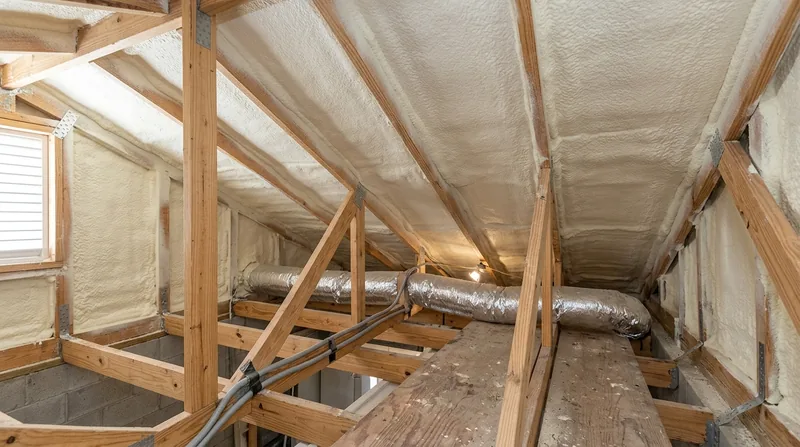




Closed cell spray foam insulation in McAllen is the engineered choice for the Valley's most demanding thermal and moisture conditions. McAllen sits on a flat subtropical delta where summer attic temperatures exceed 160°F under relentless sun, and Gulf humidity drives vapor inward year-round against concrete slab foundations. Two-pound closed-cell foam delivers R-6.5 per inch with an integral vapor retarder, stiffens roof decks against deflection, and shrugs off the flood water that comes with hurricane season. Whether you are sealing a 1950s frame home in downtown Mission, protecting a metal packing shed near Pharr, or insulating a new two-story in north McAllen, closed-cell foam is the product engineered for heat, humidity, and structural load. We have been installing spray foam insulation across the Rio Grande Valley since 2012, and we write every estimate with R-value and thickness specifications so you know exactly what you are buying. Call us at (956) 540-5716 for a free written estimate.
Why Closed Cell Spray Foam Matters in McAllen's Hot, Humid Climate
McAllen's heat load is relentless and the humidity is unforgiving. A vented attic in a Valley home sits 150 to 160°F for months, and that temperature gradient drives cooling loads into the roof decks and down through the drywall. Fiberglass batts and blown-in cellulose absorb moisture, settle, and lose R-value over time. Closed-cell foam does not absorb water, does not settle, and its vapor retarder stops humid air from migrating into the attic cavity where it would condense on cooler surfaces. Metal buildings, packing sheds, and ag storage facilities face the same problem: steel conducts heat and cold, and condensation forms on the inside of the metal when warm humid air meets a cold surface. Closed-cell foam bonds to the steel, eliminates the air gap, and stops the condensation before it starts.
- Two-pound closed-cell foam delivers R-6.5 per inch, meaning a 5.5-inch spray achieves R-36 in minimal thickness.
- The foam itself is a vapor retarder, eliminating the need for separate poly sheeting and reducing air leakage paths.
- Closed-cell foam is rigid and stiffens roof decks, reducing deflection under load and wind uplift.
- The product is water-resistant and does not degrade if briefly exposed to flood water during hurricane season.
- Closed-cell foam bonds directly to metal, concrete, wood, and masonry, creating a seamless thermal and air barrier.
For any application where humidity control and structural rigidity matter, closed-cell foam is the correct choice.
Key info: A sealed attic with closed-cell foam stops the humidity-driven condensation that ruins fiberglass and causes mold growth on roof framing. In McAllen, where summer humidity climbs above 70 percent and attic temperatures exceed 160°F, the vapor retarder built into closed-cell foam is not optional, it is structural insurance.
How We Install Closed Cell Spray Foam Insulation in McAllen
Closed-cell foam installation is a precision process. The two-part polyol and isocyanate are mixed at exact ratios, heated to the correct drum temperature, and sprayed in controlled passes to build thickness without overspray, sagging, or incomplete cure. We use mechanical ventilation during the spray and cure cycle, control the ambient temperature, and verify thickness with depth gauges at multiple points. Re-entry is safe after 24 to 48 hours, depending on ambient humidity and temperature. We do not promise immediate occupancy, and we do not spray over wet substrates, active leaks, or contaminated surfaces. If the roof is leaking or the crawl space has standing water, we walk away until the moisture is fixed.
- We inspect the attic, walls, or crawl space and identify air leakage paths, moisture sources, and any existing insulation that must be removed.
- We install mechanical ventilation and air scrubbers to manage isocyanate vapor during the spray cycle.
- We mask and protect HVAC ducts, electrical wiring, and any surfaces that should not be sprayed.
- We spray the foam in overlapping passes, building thickness from the bottom up and working systematically across the entire cavity.
- We verify thickness with depth gauges and document R-value and coverage on the final estimate.
- We ventilate the space for the full cure cycle and provide a re-entry window before you occupy the home or building.
Every job is documented with written specifications so you have proof of what was installed and where.
Local example: A 1970s brick ranch in Weslaco with a hot west wall and a vented attic running 160°F received 5.5 inches of closed-cell foam across the attic floor and the west-facing rafter cavity. The homeowner sealed the attic and eliminated the air leakage that was pulling humid outside air into the cavity. We also sealed the rim joist where the brick veneer met the concrete slab. Total coverage was 1,200 board feet. The home now holds temperature better, and the attic stays dry year-round.
For more on how we handle attic insulation, see our page on attic spray foam insulation in McAllen.
Closed Cell Spray Foam Installation Methods
| Application | Method | Best for |
|---|---|---|
| Sealed Attic | Spray foam applied to the underside of the roof deck, rafters, and gable ends, sealing the attic as a conditioned space. | McAllen homes with ductwork and air handlers in the attic; eliminates the 160°F temperature swing and moisture infiltration. |
| Metal Building Enclosure | Closed-cell foam sprayed to the underside of the metal roof and walls, bonding directly to steel and eliminating condensation cavities. | Packing sheds, produce warehouses, ag storage, and cold storage facilities near Pharr and the Harlingen area. |
| Wall Cavity Injection | Low-pressure closed-cell foam injected into existing wall cavities through small drilled ports, filling voids without demolition. | 1950s and 1960s frame homes in downtown Mission and Harlingen with hollow walls and no existing insulation. |
| Rim Joist and Band Joist | Closed-cell foam sprayed or injected along the rim joist where the brick veneer meets the concrete slab, sealing the thermal bypass. | Pier-and-beam and slab-on-grade homes across McAllen where the rim is exposed to outside air and humidity. |
| Crawl Space Encapsulation Support | Closed-cell foam sprayed to the underside of the floor system and rim joists to create a thermal and moisture barrier. | Crawl spaces where humidity control is critical and the space will be conditioned or sealed as part of a larger energy project. |
Closed Cell Spray Foam Insulation Cost in McAllen: What to Expect
Closed-cell spray foam in McAllen typically starts at $1.20 per board foot and can range from $1.20 to $2.00 per board foot depending on access, substrate condition, thickness required, and the size of the job. A 1,000 board foot attic spray runs roughly $1,200 to $2,000 before any removal or preparation work. A metal building or packing shed with 5,000 board feet can run $6,000 to $10,000. The final price depends on how many passes are required, whether existing insulation must be removed first, and whether the roof or walls are accessible from inside or require scaffolding or lifts.
We always provide a written estimate that breaks down the square footage, the board feet, the R-value, the thickness in inches, and the total labor and material cost. We do not quote a price over the phone because every attic, wall cavity, and metal building is different. A 1960s ranch with a flat attic and clear access costs less than a 1990s two-story with a cathedral ceiling and tight rafter bays. A crawl space with standing water or a wall cavity filled with old fiberglass requires removal first, which adds cost and time.
For a detailed breakdown of pricing and what affects the final number, see our full pricing page. Call us at (956) 540-5716 for a free written estimate with no obligation to book.
Closed Cell Spray Foam Insulation Near Me: What McAllen Homeowners Should Know When Hiring
Spray foam is a high-performance product, but it is only as good as the installer. A poor installation, incomplete cure, bad ventilation, or incorrect drum temperature will show up as odor, incomplete coverage, or foam that does not cure properly. Before you hire any spray foam contractor near McAllen, ask the right questions and verify what you are getting.
- Request a written estimate that includes square footage, board feet, R-value per inch, total thickness in inches, and labor and material cost broken out separately.
- Ask whether the contractor uses mechanical ventilation during the spray and cure cycle, and how long the re-entry window is.
- Verify that the contractor is fully insured and can provide a current certificate of insurance with your address listed as a certificate holder.
- Ask for references from three recent jobs in McAllen, Pharr, or Weslaco, and call them to ask about odor, cure time, and whether the contractor was responsive if questions came up after the job.
- Confirm whether any permits are required at your address and whether the contractor will help you navigate the permitting process with the local building department.
- Do not accept a price that is far below market or a promise of immediate re-entry without proper ventilation and cure time.
The best spray foam contractors in the Valley are local, reachable, and willing to put their work in writing.
If you are ready to move forward, contact us for a free estimate. We have been installing spray foam in McAllen since 2012, and we document every job with written specifications and R-value verification.
Closed Cell Spray Foam Insulation in McAllen: Pricing Guide
| Service | Price | Details |
|---|---|---|
| Closed Cell Spray Foam (standard attic or wall) | Starting at $1.20 per board foot | Two-pound closed-cell foam with R-6.5 per inch, includes labor, material, and mechanical ventilation during cure |
| Sealed Attic (1,000 to 1,500 sq ft) | Starting at $1,200 to $1,800 | Typical McAllen home attic with 4 to 6 inches of closed-cell foam across floor and rafter cavities, includes removal of old batts if present |
| Metal Building or Packing Shed | Starting at $1.50 per board foot | Closed-cell foam sprayed to underside of metal roof and walls, prevents condensation on steel, larger jobs qualify for volume pricing |
| Wall Cavity Injection or Rim Joist Sealing | Starting at $800 to $2,000 | Depends on linear footage and accessibility, typical rim joist runs 50 to 150 linear feet around the perimeter of the slab |
| Travel and Mobilization | Included | No separate travel fee or mileage charge within McAllen and surrounding service areas |
| Free Written Estimate | No charge | Includes site inspection, square footage, board feet calculation, R-value and thickness specs, and total labor and material cost |
Indicative pricing, the exact cost depends on square footage, finish, and site access. Free personalized estimate within 24h at (956) 540-5716.


