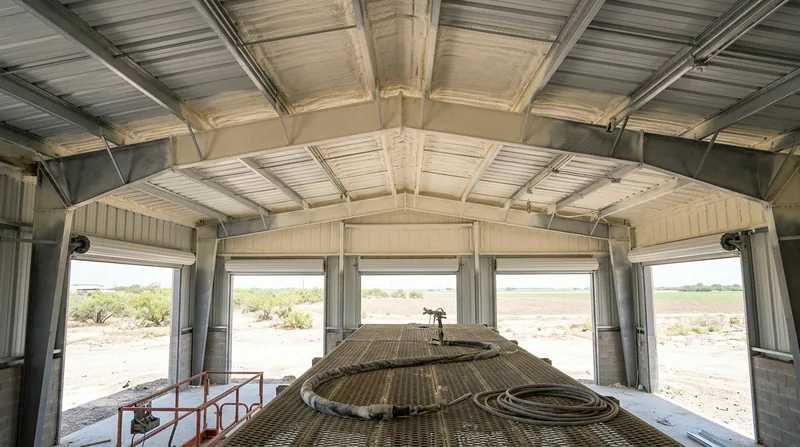




Commercial & New Construction Spray Foam in McAllen serves the fastest-growing metro in Texas, where warehouses, cold storage facilities, offices, churches and production builders demand code-compliant insulation on schedule. The Rio Grande Valley's flat subtropical terrain and year-round work cycle mean new construction runs continuously from the Pharr produce corridor to the McAllen trade zone, and every shell needs thermal control before operations begin. Spray foam delivers that control in a single application, seals the entire envelope at once, and comes with documentation your building inspector will actually accept. Whether you are framing a new warehouse, closing a metal building, or insulating a production facility mid-season, we spray to code, keep your schedule intact, and leave you with a complete thermal and air-sealed assembly. Read on to understand how commercial spray foam works in McAllen, what it costs, and how to choose the right contractor for your project.
Why Commercial & New Construction Spray Foam Matters in the Rio Grande Valley
McAllen and the surrounding valley experience some of the hottest sustained summer temperatures in Texas, with attics and roof decks regularly climbing to 150-160°F under intense solar load. New commercial construction and warehouse shells must meet current energy code, and that code increasingly demands continuous insulation with an air barrier. Fiberglass batts and blown-in cellulose cannot create an air seal on their own, leaving thermal bridging through studs, plates, and roof framing. Spray foam eliminates those gaps in a single pass, reduces the heating and cooling load on new HVAC equipment, and prevents the moisture infiltration that plagues metal buildings in humid subtropical climates. For production builders and general contractors managing tight timelines, spray foam also cures fast enough to allow the next trade to follow within 24 to 48 hours, keeping the schedule on track.
- Spray foam creates a complete thermal and air-sealed envelope in one application, eliminating gaps that fiberglass cannot fill.
- New construction code in the Rio Grande Valley requires continuous insulation, and spray foam meets that requirement on roof decks, walls, and rim joists without additional barriers.
- Metal buildings and warehouses benefit from closed-cell foam, which stops condensation on steel and prevents the moisture damage that destroys insulation in humid climates.
- Phased work and scheduling flexibility allow us to spray around your construction timeline, keeping trades moving and avoiding delays.
- Written estimates include R-value and thickness specifications, so your building inspector knows exactly what you have installed and why it meets code.
Every commercial project in McAllen faces the same challenge: intense summer heat, high humidity, and the pressure to complete on time. Spray foam solves all three.
Key info: The Pharr produce corridor and McAllen trade zone run cold storage and warehouse facilities that depend on consistent interior temperatures. Spray foam on metal buildings prevents condensation on the steel shell, which would otherwise drip onto product and destroy the insulation from below. That single advantage justifies the material cost on any large-scale commercial refrigeration or climate-controlled storage facility.
For more information on how we handle large commercial projects, visit our metal building and barndominium spray foam page, which covers the same air-sealing principles applied to agricultural and industrial structures across the valley.
How We Spray Commercial & New Construction Foam in McAllen: A Step-by-Step Process
Commercial spray foam installation is not a one-afternoon job. We start with a detailed site walkthrough to understand your building envelope, identify thermal bridging points, and plan the spray sequence around your construction schedule. We measure the square footage and depth needed, confirm the substrate is clean and dry, and coordinate mechanical ventilation during cure to protect your crew and trades working nearby. Once we spray, the foam expands to fill every cavity, seals around electrical boxes and rim joists, and cures hard enough for the next trade to follow within 24 to 48 hours. We document the work with photographs and written specifications so your building department and your insurance company have a clear record of what was installed and where.
- We conduct a free on-site consultation to measure the building envelope and identify all areas needing insulation and air sealing.
- We prepare the substrate by cleaning debris and confirming the surface is dry, because foam does not adhere to wet, contaminated or actively leaking surfaces.
- We set up mechanical ventilation during the spray and cure process to manage odor and off-gassing, protecting your crew and nearby trades.
- We spray closed-cell or open-cell foam to the specified thickness, typically 1 to 2 inches for new construction roof decks and walls.
- We document the installation with photographs, R-value calculations, and written thickness specifications for your building inspector and insurance records.
The result is a complete thermal and air-sealed assembly that passes inspection and performs as designed from day one.
Example: A production facility in San Juan needed to insulate a new 40,000-square-foot warehouse shell before the roof was closed and equipment installed. We sprayed 1.5 inches of closed-cell foam on the underside of the metal roof deck, sealing all penetrations and rim joists in a single pass over three days. The building passed the energy code inspection on first submission, and the facility was able to install its HVAC system and production equipment on schedule without waiting for insulation work to complete.
For details on how we handle attic and roof deck insulation specifically, see our attic spray foam insulation service page.
Spray Foam Methods for Commercial & New Construction
| Approach | Description | Best for |
|---|---|---|
| Closed-Cell Spray Foam | High-density foam with a closed structure, R-value 6 to 7 per inch, acts as a vapor barrier and moisture control layer. | Metal buildings, warehouse roof decks, cold storage facilities, and any application where condensation control is critical in humid climates. |
| Open-Cell Spray Foam | Lower-density foam with an open structure, R-value 3.5 to 4 per inch, allows vapor transmission and reduces material cost. | Interior walls, bonus rooms, and new construction where vapor control is handled by other means and budget is a primary driver. |
| Rim and Band Joist Sealing | Spray foam applied to the exposed wood band or rim joist where the foundation meets the wall frame, sealing a major air leak point. | New construction on slab-on-grade or pier-and-beam foundations in McAllen where air infiltration from below the frame must be stopped. |
| Wall Cavity and Injection Foam | Low-pressure injection foam applied to closed wall cavities from the exterior, filling stud bays without removing drywall or exterior cladding. | Retrofit of older commercial buildings and production facilities where new construction is not possible and the wall cavity must be filled after framing is closed. |
Commercial & New Construction Spray Foam Cost in McAllen: What to Expect
The cost of commercial spray foam insulation depends on the size of the building envelope, the type of foam (closed-cell or open-cell), the thickness required by code, and the complexity of the roof or wall assembly. A small office shell may cost less than a large warehouse, but both follow the same logic: we measure the square footage, determine the R-value and thickness your building code requires, and calculate the board feet of foam needed. Closed-cell foam costs more per board foot than open-cell, but delivers higher R-value, acts as a vapor barrier, and prevents condensation damage in metal buildings. Open-cell foam is less expensive but requires a separate vapor barrier on the interior in many climates. We provide a free commercial estimate that includes the square footage, R-value, foam type, and total cost, so you know exactly what you are paying for before we spray a single board foot.
Factors that affect commercial spray foam cost include building size (larger buildings typically cost less per square foot due to efficiency), roof or wall complexity (more penetrations and edge details increase labor), substrate condition (wet or contaminated surfaces require remediation before foam can be applied), and scheduling (phased work or tight timelines may require multiple crew visits). Travel within McAllen and surrounding areas is included in our estimate, so there is no surprise mileage fee. We recommend getting two or three estimates from local contractors so you can compare foam type, thickness, R-value, and price. Avoid any estimate that does not specify R-value, thickness, or foam type, because that is a sign the contractor does not know what they are installing.
For a detailed breakdown of pricing for our other services, visit our full pricing page, which shows typical costs for attic, crawl space, and metal building projects across the Rio Grande Valley.
What to Look for When Hiring a Spray Foam Contractor Near McAllen
Spray foam installation is a trade skill that requires proper equipment, training, and attention to detail. A bad spray foam job will smell for months, may not cure properly, and can trap moisture inside the building envelope, causing long-term damage. When you are hiring a contractor for commercial or new construction foam work, ask for references from recent commercial projects, verify that the contractor carries full insurance coverage, and request a detailed written estimate that includes R-value, foam type, and thickness specifications. Confirm that the contractor understands your local building code and can work with your building inspector. Ask whether they will use mechanical ventilation during cure and what re-entry time they guarantee. Never hire a contractor who promises immediate occupancy after spraying, because that is a sign they are not managing off-gassing properly.
In McAllen and the Rio Grande Valley, contractor registration requirements vary by city, so ask any contractor whether they carry the registration your city requires and verify it directly with your building department before work begins. Contractor licensing in Texas is handled at the municipal level, not the state level, and each city sets its own rules. We can help you understand what applies at your address and ensure your project meets local requirements. Always get multiple estimates, ask each contractor for proof of insurance, and check references from recent commercial projects in your area. If a contractor cannot provide a detailed estimate with R-value and thickness, or if their price is far below market with no inspection, walk away.
Ready to get started on your commercial or new construction spray foam project? Contact us for a free estimate or call (956) 540-5716 to discuss your building, your timeline, and your budget. We will provide a detailed written estimate within 24 hours, with no obligation to book.
Commercial & New Construction Spray Foam in McAllen: Pricing Guide
| Service | Price | Details |
|---|---|---|
| Free Commercial Estimate | Free | On-site consultation, square footage measurement, R-value and thickness specification, written cost breakdown with no obligation |
| Closed-Cell Spray Foam | Starting at $1.50 per board foot | High-density foam for metal buildings, cold storage, and roof decks where condensation control and vapor barrier are required |
| Open-Cell Spray Foam | Starting at $0.75 per board foot | Lower-density foam for interior walls and new construction where vapor control is handled separately and material cost is a driver |
| Rim Joist and Band Joist Sealing | Starting at $400 per project | Air sealing at the foundation-to-frame interface, typically 50 to 150 linear feet depending on building footprint and foundation type |
| Large Warehouse or Metal Building | On Estimate | Square footage, roof complexity, and phasing requirements determine final cost; we schedule site visits and provide detailed specifications before pricing |
| Travel and Scheduling | Included | No separate mileage or travel fee within McAllen and surrounding Rio Grande Valley service areas; phased work coordinated around your construction timeline |
Indicative pricing, the exact cost depends on square footage, finish, and site access. Free personalized estimate within 24h at (956) 540-5716.


