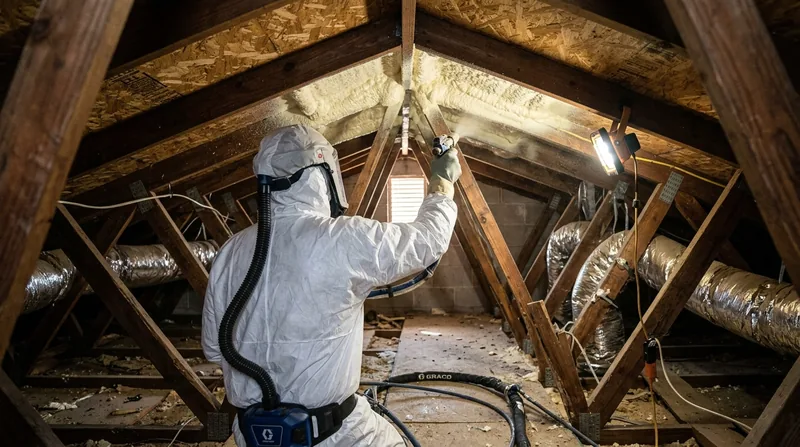




Open Cell Spray Foam Insulation in McAllen is the cost-effective answer to the brutal Rio Grande Valley heat. McAllen sits on a flat subtropical delta where almost every home perches on a concrete slab with a vented attic above it, and that attic routinely hits 150 to 160 degrees Fahrenheit under some of the hottest sun in the country. Half-pound open-cell foam air-seals those attics and interior walls at a friendlier price per board foot than closed cell, and it brings sound dampening between bedrooms and townhome units as a bonus. Whether you own a 1950s frame house in historic downtown McAllen, a 1970s brick ranch in Pharr or Weslaco, or a newer two-story in north McAllen or Edinburg, open cell delivers the air sealing that stops the conditioned air from leaking into that furnace of an attic. We spell out plainly where open cell belongs and where flood exposure or a cold room calls for closed cell instead.
Why Open Cell Spray Foam Matters in McAllen's Hot Attics
McAllen's climate is relentless. The subtropical heat, coupled with Gulf humidity that pushes moisture inward year-round, makes attic air sealing the difference between a home that cools efficiently and one that bleeds money into the outdoor air. Standard fiberglass batts and blown-in cellulose leave gaps at rim joists, around ductwork, and at the framing where walls meet the roof deck. Open-cell foam expands to fill every cavity and crack, creating a continuous air barrier that stops the leak at its source. In a region where air conditioning runs hard nine months a year, that matters.
- Open-cell foam expands to fill cavities and gaps that fiberglass leaves open, stopping air leakage at the source.
- The material provides an R-value of approximately 3.6 to 3.8 per inch, sufficient for attic and interior wall applications in McAllen's climate.
- Sound dampening between bedrooms and between townhome units comes standard, a real benefit in subdivisions across Pharr, San Juan, and Weslaco.
- Lower cost per board foot than closed cell makes open cell the smart choice when moisture and flood risk are not present.
- We install it correctly: controlled thickness per pass, proper manufacturer ratio, mechanical ventilation during cure, and a clear twenty-four to forty-eight hour re-entry window.
The bottom line: open-cell foam stops the air leakage that makes your air conditioner work twice as hard as it should.
Key info: A 1970s brick ranch in Pharr with a vented attic and no air sealing loses conditioned air through rim joists, ductwork penetrations, and gaps at the roof line. Open-cell foam seals those paths for a fraction of what closed cell costs, and it delivers the air barrier that keeps that 155-degree attic from pulling cool air out of the living space below.
How We Install Open Cell Spray Foam Insulation in McAllen
The process is straightforward and safe when done right. We start with a site visit to assess your attic or wall cavity, identify air leaks, and confirm that the substrate is dry and clean. We then set up mechanical ventilation to pull fumes during the spray and cure process, establish a clear re-entry window, and spray the foam in controlled passes to build the specified thickness without over-application. Every job comes with written estimates that spell out the R-value and thickness we will achieve, so you know exactly what you are getting.
- We inspect the attic or wall cavity, check for moisture, verify substrate condition, and identify all air leakage points.
- We set up mechanical ventilation to exhaust fumes during spray and cure, ensuring safe air quality during and after application.
- We mask and protect HVAC equipment, ductwork, electrical boxes, and any recessed lights or fixtures in the spray zone.
- We spray the foam in multiple controlled passes, building to the specified thickness without exceeding manufacturer guidelines.
- We confirm the twenty-four to forty-eight hour re-entry window and provide written documentation of what was installed and where.
The result is a continuous air barrier that stops leakage and improves comfort immediately.
Example: A 1960s frame home in Mission with a vented attic and original fiberglass batts has gaps at the rim joist and around the return air plenum. We remove the loose batts, seal the rim joist and plenum with open-cell foam, then top-coat the attic with additional open cell to R-30. The air barrier stops the leak, the attic stays cooler, and the air conditioner runs easier. See our attic spray foam page for more on sealed attics.
Open Cell Spray Foam Installation Methods and Applications
| Application | Description | Why It Works in McAllen |
|---|---|---|
| Attic Air Sealing | Open-cell foam sprayed on the roof deck, rim joist, and around ductwork penetrations to create a continuous air barrier. | Stops the hot attic from pulling conditioned air upward through leaks in the framing and rim joist. |
| Interior Wall Cavities | Open-cell foam injected into existing wall cavities without demolition, sealing the cavity and adding insulation value. | Addresses the hot west walls of 1970s and 1980s ranches in Pharr and Weslaco without tearing down drywall. |
| Sound Dampening Between Units | Open-cell foam sprayed into cavities between bedrooms or townhome units to reduce sound transmission. | Common in subdivisions across Weslaco, San Juan, and McAllen where townhomes and duplexes share walls. |
| Garage Ceilings and Band Joists | Open-cell foam sprayed on the underside of garage roof decks and at the band joist to seal and insulate. | Stops hot air from the garage from entering the living space above, a common issue in newer two-stories across Edinburg and north McAllen. |
| Top-Up Over Existing Batts | Open-cell foam sprayed over sound fiberglass or cellulose batts to fill gaps and add coverage where batts are thin. | Cost-effective upgrade when the existing insulation is intact but leaves gaps at rim joists or ductwork. |
Open Cell Spray Foam Insulation Cost in McAllen: What to Expect
Open-cell spray foam pricing in McAllen starts at approximately $0.55 per board foot, making it the most cost-effective foam option for attics and interior walls. The final cost depends on the size of the area, the thickness required to meet your R-value target, accessibility for the spray rig, and whether the job includes removal of existing insulation. A typical attic top-up runs between $1,500 and $3,500 depending on square footage and condition. Wall cavity injection in a 1970s ranch runs $800 to $2,000 per wall, depending on cavity depth and linear footage. Rim joist sealing alone costs $400 to $1,200 for an average home. Getting two to three estimates from local contractors is always smart, so you can compare thickness specifications, R-value targets, and labor approach. See our full pricing overview for detailed ranges and the factors that move the cost up or down.
What to Look for When Hiring a Spray Foam Insulation Contractor Near McAllen
Not all spray foam installers are equal. The trade includes both local independent shops and out-of-state rig-and-run crews that spray in an afternoon and disappear when the smell or the performance does not meet expectations. A good contractor, whether local or national, follows these standards: a written estimate that spells out R-value and thickness in board feet, not a vague price per square foot; mechanical ventilation during spray and cure; a clear re-entry window of twenty-four to forty-eight hours; insurance that you can verify; and a willingness to walk away if the substrate is wet, contaminated, or leaking. Ask any contractor to provide proof of insurance and to confirm what municipal contractor registration, if any, applies at your address. Texas regulates contractors at the city level, not the state level, so the rules vary from McAllen to Edinburg to Harlingen. Call your city building department and ask what registration or permit is required before any work begins, then verify that your contractor holds it. References from recent jobs in your neighborhood are worth their weight in gold. Contact us for a free estimate and written specifications, and we will walk you through the whole process.
Red flags to avoid: An estimate with no R-value or thickness specified. A promise of immediate re-entry (you need forty-eight hours minimum). A price far below market with no on-site inspection. Insurance that cannot be verified with a phone call to the carrier. A crew that does not set up mechanical ventilation during spray and cure. If you see these signs, ask a different contractor.
Open Cell Spray Foam Insulation in McAllen: Pricing Guide
| Service | Price | Details |
|---|---|---|
| Attic air sealing and top-up | Starting at $0.55/board ft | Open-cell foam sprayed on roof deck and rim joist; cost rises with square footage and thickness needed to reach target R-value |
| Interior wall cavity injection | Starting at $0.55/board ft | Retrofit of existing walls without demolition; final cost depends on cavity depth, linear footage, and accessibility of injection points |
| Sound dampening between units | Starting at $0.55/board ft | Open-cell foam in shared walls or ceilings; pricing scales with wall area and cavity configuration in townhomes and duplexes |
| Rim joist and band joist sealing | Starting at $400 | Targeted air sealing of the rim joist perimeter; cost depends on linear footage and whether removal of existing insulation is required |
| Removal of failed or deteriorated insulation | On estimate | Old batts, wet cellulose, or settled foam must be removed before new insulation; scope and disposal determine the final price |
| Free written estimate | No charge | On-site inspection with R-value and thickness specifications; response within 24 hours at (956) 540-5716, no obligation to book |
Indicative pricing, the exact cost depends on square footage, finish, and site access. Free personalized estimate within 24h at (956) 540-5716.


