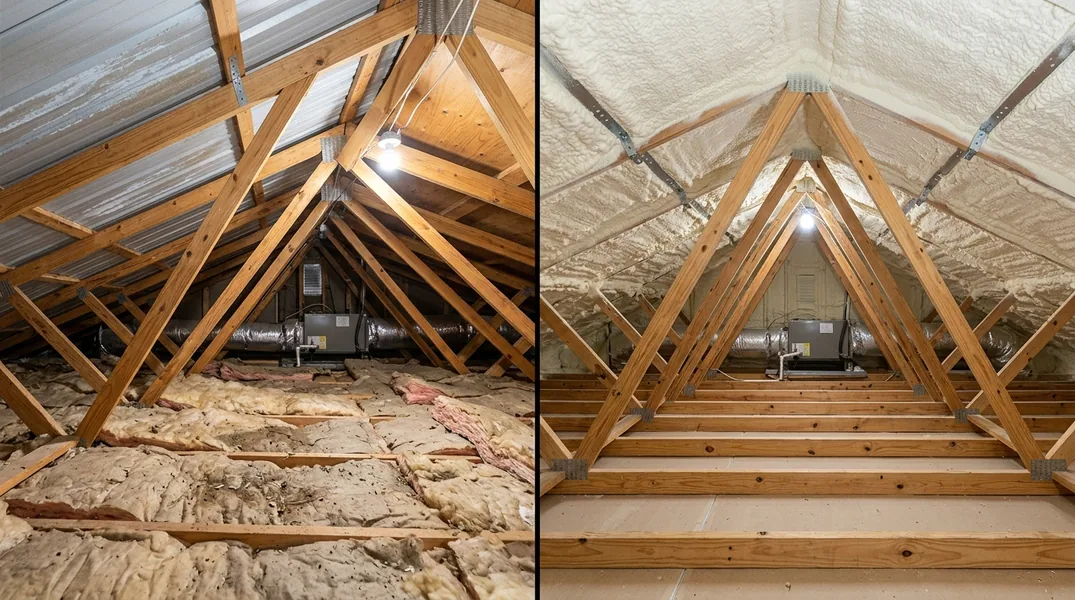
Understanding Spray Foam Insulation Basics
When you're evaluating insulation options for your home in McAllen, spray foam has become one of the most popular choices for good reason. Unlike traditional fiberglass batts or blown-in cellulose, spray foam expands to fill every crack and crevice, creating an air-tight seal that significantly reduces energy loss. But not all spray foam is created equal, and understanding the differences between open-cell and closed-cell varieties is crucial before making your decision.
Both types of spray foam start as liquid components that are mixed and sprayed into place, where they expand and harden. The fundamental difference lies in their cellular structure. This structural difference affects everything from performance and durability to cost and environmental impact. For homeowners in McAllen dealing with the intense heat and humidity of the Rio Grande Valley, understanding these distinctions will help you choose the right solution for your specific needs.
What is Open Cell Spray Foam Insulation?
Open Cell Spray Foam Insulation has a structure where the cells are not completely closed off from one another. Picture a sponge with interconnected pores, and you'll have a good mental image of open-cell foam. When the foam expands and cures, it remains somewhat flexible and softer than its closed-cell counterpart. This open structure means that water and air can pass through the foam more easily, which has both advantages and disadvantages depending on your application.
The primary benefit of open-cell foam is its lower cost compared to closed-cell options. It typically provides an R-value of around 3.5 to 3.6 per inch, which is respectable for many residential applications. Open-cell foam is also excellent at sound dampening, making it a popular choice for interior walls and spaces where noise reduction matters. Additionally, because it's more permeable, it allows walls to dry out if moisture does penetrate, which can be beneficial in certain climates. However, open-cell foam is not moisture-resistant and should never be used in areas prone to water exposure or in exterior applications where it might absorb moisture.
What is Closed Cell Spray Foam Insulation?
Closed Cell Spray Foam Insulation features cells that are completely encapsulated and sealed from one another. This creates a denser, more rigid foam structure that is fundamentally different from open-cell in performance and characteristics. The closed cellular structure makes this foam much more resistant to moisture penetration and provides superior structural support, which is why it's often used in demanding applications.
The closed cell spray foam R value is significantly higher than open-cell, typically ranging from 6.0 to 7.0 per inch of thickness. This means you need less material to achieve the same insulation performance, which is particularly valuable in applications where space is limited. Closed-cell foam is completely moisture-resistant, making it ideal for basements, crawl spaces, exterior walls, and any area that might come into contact with water. It also provides additional structural rigidity to walls and roofs, which can be an added benefit. The trade-off is that closed-cell foam costs considerably more than open-cell, and it's less permeable, which means any moisture trapped within it cannot easily escape.
Spray Foam R Value Comparison: Which Performs Better?
When comparing insulation options, R-value is one of the most important metrics homeowners consider. The closed cell spray foam R value of 6.0 to 7.0 per inch is nearly double that of open-cell foam at 3.5 to 3.6 per inch. This means that if you need to achieve an R-value of 30 in your attic, you would need approximately 8 to 9 inches of open-cell foam but only 4 to 5 inches of closed-cell foam. For homeowners with limited attic space or structural constraints, closed-cell foam allows you to achieve higher R-values without consuming excessive space.
However, R-value alone doesn't tell the complete story. Open-cell foam still provides excellent insulation and air sealing properties, especially when applied to adequate depths. The choice between the two often comes down to your specific application, budget, and long-term goals. For Attic Spray Foam Insulation in the Rio Grande Valley, where cooling costs can be substantial, the higher R-value efficiency of closed-cell foam might justify the additional investment. However, if you're insulating interior walls or have budget constraints, open-cell foam can still deliver solid performance at a more accessible price point.
Attic Spray Foam Insulation Cost in McAllen: What to Budget
Cost is often the deciding factor for homeowners choosing between open-cell and closed-cell spray foam. Open-cell foam typically costs between $0.50 and $1.00 per board foot, while closed-cell foam ranges from $1.50 to $3.00 per board foot or more, depending on regional factors and specific product specifications. For a typical 1,500 square foot attic with 6 inches of insulation, you might expect to pay $1,500 to $3,000 for open-cell foam compared to $4,500 to $9,000 or more for closed-cell foam. These are rough estimates, and your actual project cost will depend on your specific situation, accessibility, and local market conditions.
While closed-cell foam carries a higher upfront cost, many homeowners find the investment worthwhile due to superior performance, durability, and energy savings over time. The higher R-value means better cooling efficiency in McAllen's hot climate, which can translate to lower utility bills for years to come. To get an accurate assessment of what your project will cost and which option makes the most financial sense for your home, we recommend reaching out for a free estimate. McAllen Spray Foam Insulation can evaluate your specific needs and provide transparent pricing for both options.
Choosing the Right Foam for Your McAllen Home
Deciding between open-cell and closed-cell spray foam ultimately depends on several factors specific to your situation. Consider the application first: are you insulating an attic, basement, crawl space, or exterior walls? Closed-cell foam is the clear choice for any area that might contact moisture or water. For interior applications in dry environments like attics, either option can work, but closed-cell provides superior performance in McAllen's intense heat. Think about your budget and long-term energy goals. If you plan to stay in your home for many years and want maximum energy efficiency, closed-cell foam's higher R-value and superior performance justify the investment. If you're on a tighter budget or insulating areas where moisture isn't a concern, open-cell foam remains a solid, cost-effective choice.
Climate also plays a role in this decision. McAllen experiences hot, humid summers and mild winters, with cooling costs typically exceeding heating costs. The superior insulation properties of closed-cell foam can provide meaningful energy savings in this climate. Additionally, closed-cell foam's structural properties and moisture resistance make it better suited to the Rio Grande Valley's humidity levels. Whatever you decide, working with experienced professionals ensures your spray foam is installed correctly to maximize its performance and longevity. If you're ready to explore your options, contact McAllen Spray Foam Insulation at (956) 540-5716 or visit our website to discuss your project and receive a personalized recommendation.
Looking for a professional spray foam insulation contractor in McAllen? McAllen Spray Foam Insulation responds fast for all your spray foam insulation needs.
Get a Free Quote