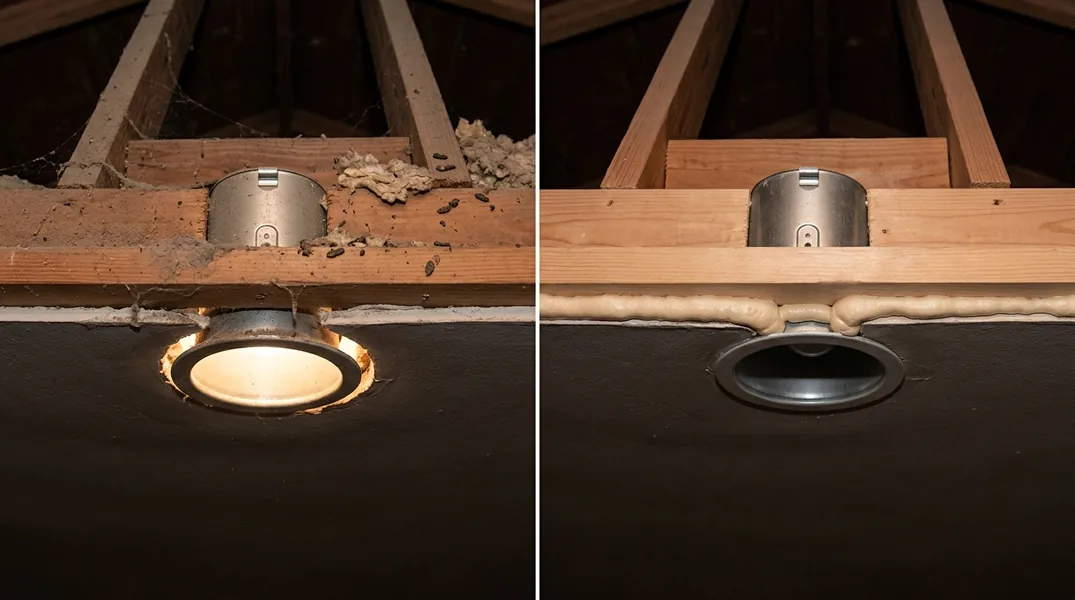
Understanding the Core Difference: Spray Foam vs Blown-In Insulation
When homeowners in McAllen start researching attic insulation upgrades, they quickly encounter two dominant options: spray foam and blown-in insulation. While both serve the same goal, they work in fundamentally different ways, and understanding those differences is crucial to making the right choice for your home.
Attic Spray Foam Insulation is applied as a liquid that expands and hardens into a solid, continuous layer. This creates an air-tight seal that blocks both heat transfer and air infiltration. Blown-in insulation, by contrast, consists of loose fibers (fiberglass, cellulose, or mineral wool) that are pneumatically installed into cavities and attic spaces. These materials settle and compress over time, leaving small air gaps between particles. The spray foam approach creates a thermal and air barrier in one application, while blown-in materials rely on density and depth to resist heat flow.
The practical implication is significant: spray foam fills every nook, crevice, and irregular space, while blown-in insulation depends on proper depth and undisturbed coverage to perform well. In an older McAllen home with an oddly shaped attic or multiple penetrations for pipes and wiring, this difference becomes very real.
Spray Foam vs Fiberglass: The Performance Conversation
Fiberglass is the most common blown-in insulation material, and for good reason. It is affordable, non-combustible, and relatively easy to install. However, when comparing spray foam vs fiberglass, the performance metrics tell a different story depending on your specific situation. Fiberglass achieves an R-value of roughly 3.2 to 3.8 per inch of depth. Spray foam typically delivers R-5 to R-7 per inch, meaning you need significantly less material to achieve the same thermal resistance.
But here's where honesty matters: not every attic needs spray foam. If your fiberglass insulation is already at the recommended depth for your climate zone and in good condition, a simple top-up with additional fiberglass may be the most cost-effective solution. The U.S. Department of Energy recommends R-38 to R-60 for attic insulation depending on your climate, and the Rio Grande Valley falls into a moderate zone. If your current setup is already close to target, you might not need a complete overhaul. However, if you have air leaks, inadequate depth, or moisture issues, spray foam becomes the more practical long-term investment.
Spray Foam vs Cellulose: Moisture and Longevity Considerations
Cellulose is an eco-friendly blown-in option made from recycled paper, and it performs well in dry climates. However, McAllen sits in South Texas, where humidity is a constant factor. This is where spray foam vs cellulose becomes a critical comparison for local homeowners. Cellulose is hygroscopic, meaning it absorbs moisture from the air. In a humid environment, cellulose can settle more aggressively, lose R-value over time, and create conditions favorable to mold growth if not properly ventilated.
Closed Cell Spray Foam Insulation is inherently moisture-resistant. It does not absorb water and actually provides a vapor barrier, which helps protect your attic from humidity-related damage. Open Cell Spray Foam Insulation is more permeable but still outperforms cellulose in humid conditions because it does not degrade or lose structural integrity when exposed to moisture. If your home has experienced any past water intrusion or if you live in a particularly humid pocket of McAllen, this factor alone may justify the investment in spray foam over cellulose or fiberglass.
The Honest Assessment: When a Top-Up Is Enough
Not every insulation job requires a complete replacement or a switch to spray foam. This is the conversation McAllen Spray Foam Insulation has with homeowners regularly, and it is the right one to have. If your attic insulation is relatively recent, undamaged, and at or near the recommended R-value for your area, adding more of the same material may be the smart choice. A top-up of blown-in fiberglass or cellulose is considerably less expensive than a full spray foam installation, and it can meaningfully improve your home's thermal performance without major disruption.
The key questions to ask yourself are: Is your existing insulation compressed, settled, or damaged? Are you experiencing air leaks around penetrations, or do you feel drafts in certain rooms? Has your energy bill climbed noticeably? Are there signs of moisture, mold, or pest activity in the attic? If you answer yes to any of these, a simple top-up will not solve the underlying problem. But if your attic is reasonably well-insulated, dry, and intact, adding depth to your current material is a practical, budget-friendly step.
Attic Spray Foam Insulation Cost in McAllen: What to Budget
Cost is always a factor in the spray foam vs blown-in decision. Blown-in insulation, whether fiberglass or cellulose, typically costs between 0.50 to 1.50 per square foot installed. A 1,500-square-foot attic might run 750 to 2,250 dollars for blown-in material. Spray foam is more expensive upfront, generally ranging from 1.50 to 3.50 per square foot depending on the type and thickness. The same 1,500-square-foot attic could cost 2,250 to 5,250 dollars for spray foam.
However, the comparison does not end at installation cost. Spray foam typically lasts the lifetime of your home without settling, degrading, or requiring top-ups. Blown-in insulation may need refreshing or top-ups every 15 to 20 years. Over a 30-year period, the total cost of ownership often favors spray foam, especially when you factor in energy savings. Closed cell spray foam offers superior air sealing and can reduce HVAC strain in the Texas heat. For detailed pricing tailored to your specific attic size and condition, reach out to McAllen Spray Foam Insulation at (956) 540-5716 for a free estimate.
Making Your Decision: When to Call the Professionals
The best insulation for your attic depends on your current situation, your budget, and your long-term goals. If you own an older home with an uninsulated or poorly insulated attic, spray foam is typically the superior choice because it addresses air leaks and thermal bridging simultaneously. If your attic is already reasonably well-insulated and you simply need to boost R-value, a thoughtful top-up may be the honest answer. If you are in a newer home with cellulose or fiberglass that is still in good shape, maintaining what you have might be the right call for now.
The only way to know for certain is to have a professional assessment. McAllen Spray Foam Insulation serves homeowners throughout McAllen and the surrounding areas, and we pride ourselves on honest recommendations. We will evaluate your current insulation, identify air leaks and moisture issues, and recommend the solution that actually fits your needs and budget, not just the most expensive option. Whether you ultimately choose spray foam, blown-in, or a strategic combination of both, you deserve guidance based on your home's unique characteristics. Call us today at (956) 540-5716 or visit our website to schedule your free estimate.
Looking for a professional spray foam insulation contractor in McAllen? McAllen Spray Foam Insulation responds fast for all your spray foam insulation needs.
Get a Free Quote